


- Details
- Written by Atanas Kostov
Türk İnovasyonunu Avrupa’ya Taşıyın: Fikri Mülkiyetinizi Iusauthor Hukuk Bürosu ile Güvence Altına Alın.
Türkiye, patent başvuruları, marka tescilleri ve endüstriyel tasarımlar alanında dünyanın önde gelen ülkeleri arasında yer alarak küresel ölçekte önemli bir inovasyon merkezi hâline gelmiştir. Türk şirketleri Avrupa pazarındaki faaliyetlerini hızla genişletirken, fikri mülkiyet (FM) haklarının korunması yalnızca hukuki bir formalite değil, sürdürülebilir büyüme ve rekabet avantajı için stratejik bir zorunluluktur.
Avukat Feyzullah Yusein tarafından yönetilen Iusauthor Hukuk Bürosu, fikri mülkiyet hukuku alanında uzmanlaşmış hukuki hizmetler sunarak Türk şirketlerinin Avrupa Birliği ve uluslararası pazarlara güvenli bir şekilde giriş yapmalarına, faaliyet göstermelerine ve fikri mülkiyet varlıklarını etkin biçimde korumalarına destek olmaktadır.
Kapsamlı Fikri Mülkiyet Hizmetleri
- Details
- Written by Atanas Kostov

拓展中国创新成果至欧洲:与 Iusauthor 律师事务所携手,全面保护您的知识产权
中国已成为全球创新的重要引擎,在专利、商标和工业设计申请数量方面始终位居世界前列。随着越来越多的中国企业积极开拓欧洲市场,知识产权(IP)的保护已不仅仅是一项法律程序,更是实现企业可持续发展和提升国际竞争力的重要战略保障。
Iusauthor 律师事务所由律师 Atanas Kostov 领导,专注于知识产权法律服务,为中国企业进入欧洲联盟及国际市场、开展业务并保护其知识产权资产提供专业、高效的法律支持。
全面的知识产权法律服务
- Details
- Written by Atanas Kostov

The Crypto Assets Act in Bulgaria will come into force by the summer of 2025.
Bulgaria is taking a step towards regulating the rapidly growing crypto market with the creation of the first-ever Crypto Asset Markets Act. At its meeting today, the government approved the draft law, which aims to create a clear and stable legal framework for the activities of crypto asset service providers and token issuers.
The bill for the Crypto Assets Act was first presented in August 2024. It comes in response to the European Regulation on Markets in Crypto Assets (MiCa) coming into force this year - 2025, which Bulgaria, as a member state of the European Union, is obliged to transpose.
- Details
- Written by Atanas Kostov
New requirements for entry in the National Revenue Agency for crypto businesses.
Persons who, by occupation, provide services for the transfer or exchange, storage or management of virtual assets , allowing control over them, as well as services related to the public offering of virtual assets, are subject to entry in an electronic public register at the National Revenue Agency (Art. 9a , paragraph 1 of the Law on Measures against Money Laundering).
The requirement is in sync with the changes adopted by the National Assembly of the Republic of Bulgaria in the ZMIP and Ordinance No. H-9 of August 7, 2020 , which enter into force on March 22, 2024.
Companies and individuals subject to entry in the register must submit an application immediately before starting their activities. It is sent to the revenue agency electronically with a qualified electronic signature to the email: This email address is being protected from spambots. You need JavaScript enabled to view it. or through the Secure Electronic Delivery System (ESD).
- Details
- Written by Atanas Kostov


A Bulgarian woman has applied for a trademark similar to Hell's kitchen!
An interesting fact from reality is that on 15.02.2024 Mrs. Natalia Kartalova applied to the Bulgarian Patent Office for the national figurative mark "NASHA KUHNYA" with entry No. 2024172522 in three classes according to the Nice classification, one of which is also class 43: restaurant activity.
The figurative element of the mark in question is similar to a high degree to the European, well-known trademark HELL'S KITCHEN, which is the intellectual property of the English production company "ITV Studios Limited", realizing the famous television show under this brand worldwide, on the basis of a franchise marketing policy.
- Details
- Written by Atanas Kostov

MAS introduces new crypto regulations, including digital asset custody.
The Monetary Authority of Singapore (MAS) has introduced cryptocurrency-related amendments to the Payment Services Act, focusing on digital payment token (DPT) service providers. Alongside this, it has published guidelines for digital asset custody.
The Act has been expanded to regulate three types of additional services:
- Digital asset custody
- Payments or transfers involving tokens, even if the service provider does take possession of the DPTs
- Cross-border payments, regardless of whether the funds are within Singapore.
The announcement includes transitional arrangements for existing providers who need to become licensed. These providers must notify MAS within 30 days.
MAS also provided detailed guidelines concerning digital asset custody following a consultation and an outline of the pending rules last November.
- Details
- Written by Atanas Kostov

France’s AMF issues warning against BITGET for unauthorized digital asset services.
The French Financial Markets Authority, the Autorité des Marchés Financiers (AMF), warned against BITGET, citing unauthorized digital asset services. The AMF regularly updates its black lists of new websites and entities “proposing typical investments to investors in France without being authorized.”
According to the regulator, blockchain exchange Bitget has been offering investment products without being authorized to provide such crypto services. To protect investors from potentially fraudulent investments, AMF and the French Prudential Supervision and Resolution Authority (ACPR) added Bitget to the updated list of unauthorized investment providers to be blacklisted.
The monetary and financial code in France requires mandatory registration as a digital asset service provider (PSAN) for specific activities related to digital assets, such as custody services, buying or selling digital crypto assets, and operating digital asset trading platforms. This registration ensures compliance with regulations aimed at preventing money laundering and terrorism financing, as well as ensuring the integrity and competency of management and shareholders, thereby protecting the interests of investors.
- Details
- Written by SEO

Interview by Mr. Atanas Kostov on the realities of Bulgarian intellectual property.
1.Dear Mr. Kostov, could you introduce to our readers the law firm "IUSAUTHOR" - after all, it is one of the leading law offices in Bulgaria in the field of intellectual property protection?
With pleasure. The law firm “IUSAUTHOR” was established in 2004, and to this day, almost 20 years later, it deals exclusively with intellectual property. I always say that our law firm is small, kind of boutique. It has, for example, created and trained several PhDs in law, and we have had many interesting cases over the years - we won an opposition case against Facebook, who opposed a trademark of a Bulgarian applicant that still exists today. Recently we settled the Chudomir(one of the most famous Bulgarian righters) copyright case, with a record compensation award for copyright claims in Bulgaria - 34,000 BGN, and last month we achieved a new record in this respect - 68,000 BGN compensation for copyright infringement, with the claim concerning unauthorised use of audio-visual content filmed in Bulgaria by Austrian producers.
What I am most proud of is that the website of "IUSAUTHOR" has turned into an open, completely free online library for content (articles, news) that concerns entirely intellectual property. Some of the material has been read over 50 000 times. Perhaps this is also due to the fact that in 2022 we were nominated and received an award for Law Firm of the Year in Bulgaria. At the moment, the firm employs 5 people, including 4 lawyers and one technical assistant. One of my colleagues, who deals entirely with Internet law and blockchain technologies, is a French colleague, a lawyer - Martin Groan, who graduated in law at the Sorbonne. We have been friends for many years and I finally managed to convince him to start working for us, as he has been living and working in Bulgaria for 14 years.
2.What do you think are the most significant changes in the intellectual property system that should be made nationally?
In recent years, several key directives and regulations have been implemented in Bulgarian legislation, which still cannot be understood by the Bulgarian court as law enforcement. What do I mean?
As you know, Directive 2004/48/EC (the so-called IPRED Directive) was implemented into Bulgarian law as early as 2006. To date, its Article 13, which is enshrined in a total of 6 special tort actions in Bulgarian intellectual property law (two each in the Bulgarian Copyright act, the The Industrial design act and Trademark and geographical indications act) has not been properly applied, as the principle of royalties as the basis for possible compensation is totally incomprehensible to Bulgarian judges and they enforce their decisions through the mechanism of Article 45 by the Law on Obligations and Contracts, which is a complete legal mistake, leading to failure to prove the amount of the claim, unlawful reduction of its amount and in many cases to losing the case due to ignorance of this mechanism.
The CJEU in its reference for a preliminary ruling in case C-367/15, Stowarzyszenie "Oławska Telewizja Kablowa" v. Stowarzyszenie Filmow- ców Polskich, says that the royalty that the injured party would have received should be multiplied by two, and in some cases by three, in order to achieve the principle of general prevention in intellectual property law, i.e. to punish someone with the logical civil sanction that is sufficiently fair and has a deterrent and educational character.
I will give an example to make myself understood. If a tort claim is brought under Article 95a of the Bulgarian Copyright act for 10,000BGN in pecuniary damages and an expert in the case has determined that the eventual royalty that the author should receive is 3,000BGN, the Bulgarian court did not multiply this amount by three (as the CJEU says is correct in order to comply with the mechanism of Article 13 of the IPRED Directive), but divided by three, awarding costs to the losing party for the rejected part of the claim - an unlawful argument of Article 78(3) of the Bulgarian Code of Civil Procedure(CCP).
Here we come to the next legal paradox in Bulgarian intellectual property law, which the Bulgarian court imposes as surreal illegality. It turns out that the winning party very often actually loses the case because the court awards the losing defendant costs that are proportionate to the rejected part of the claim, which in most cases are higher than the damages awarded, because the Bulgarian court does not apply Article 13 of the IPRED directive. Moreover, the Bulgarian court has not even read Article 14 of the same Directive 2004/48/EC, which states that the losing party is not entitled to costs and must bear the costs and fees of the injured party, i.e. this special rule derogates from the general rule of Article 78(3) of the CCP! But who to read! It is difficult!
The last time I explained this to the judges at the Sofia Court of Appeals, they told me that "because I graduated abroad" (I graduated from Plovdiv University, according to my information), maybe I don't interpret correctly the CCP and that's why I talk to them so much about Directives. I had to explain that it is high time Bulgarian judges to accept law mostly as a science and read it carefully, because Directive 2004/48/EC is a fact in Bulgarian jurisdiction since 2005 and ignorance of this fact, and not applying its Article 13 and Article 14 correctly leads to brutal legal absurdities in Bulgarian law practice of the type "to win a case, but actually lose it" and all this to be "legal"!
3.Why are you so harsh in your statement towards the Bulgarian judiciary, please explain?
I just dream of objectivity, respect and law enforcement on a scientific level, nothing more. I need to give one more example on the topic. Years ago I wrote an article about software patents. You know that they were originally unpatentable, but an English judge reversed the case law on the subject not only in England, but all over the world. How does that happen?
The English magistrate in question was an examiner at the UK Patent Office before he started his career as a judge, and from there he knew in detail the technical features of patents as a legal framework and issues. In his panel as a judge a case arose about bronze casting in a blast furnace, which process was monitored by computer. What happens? The bronze is cast at exactly 1000 degrees temperature. If that temperature drops, the blast furnace bursts and dozens of workers in the foundry die. Recognizing this fact, the English judge decided that since the software provided the technical function of casting the bronze at the exact temperature, the patent for this process was patentable, as opposed to the prior practice that "software inventions have no technical function," hence "are not patentable."
I have made the case study. "The Bear" turned out to be one of the most famous trademarks in the USA. I wrote an opinion at my client's request and sent it to the New York court online. The court accepted it and considered it, along with the other evidence in the case, without me being a lawyer with legal capacity in the US. But that didn't change things. My client had infringed a trademark that was common knowledge in the US and the $110,000 trademark infringement claim was upheld. I'll say it again - $110,000 for a carpet. You may already suspect that I'm going to say that's not going to happen here in Bulgaria anytime soon, because it doesn't hold up to having innovative businesses here, nor does it read anything other than "bankruptcy", even though the most innovative, multi-billion dollar businesses are behind some domains. On that base the Bulgarian judges ruled that the domains are "not a commercial activity" and therefore "could not be trademarked"! This is a 21st century decision of the Bulgarian Supreme Court of Cassation!
To conclude with the absurd examples of Bulgarian law enforcement, I will say that for nearly 7-8 years the Commission for Protection of Competition, Sofia Administrative Court and Supreme Administrative Court have been amicably accepting "as legally correct" that unfair competition is not part of industrial property, and this nonsense, which is unprecedented in its size, was initially put into use by the "great legal advisers" of the Commission for Protection of Competition, and it has post facto become a leitmotif of the Sofia Administrative Court and Supreme Administrative Court in cases concerning Article 35, paragraph 1, paragraph 2 and paragraph 3 of the Unfair competition act, i.e. imitation of designs, trademarks and domains, obviously all objects of industrial property!
I have been explaining for several years in all these cases to the Commission for Protection of Competition, Sofia Administrative Court and Supreme Administrative Court that law is still (in my impression at least) a science, and this science says that there is a Paris Convention on Industrial Property. This Convention was ratified in Bulgaria by Decree No. 633 of the Presidium of the National Assembly of 2.09.1965 - State Gazette No. 75 of 24.09.1965. 75 of 24.09.1965. So, it is a scientific fact since 1965 that Article 10bis of the Paris Convention on Industrial Property says that unfair competition is part of industrial property, considering in detail all its objects subject to imitation, as this identically was done in the hypothesis of Article 35, paragraph 1 and paragraph 2 of the Unfair competition act, without the hypothesis of paragraph 3, because in the 1950s domains did not yet exist.
In this context, I find what has been said to be a scientific fact and I hope that in the near future the Commission for Protection of Competition, Sofia Administrative Court and Supreme Administrative Court will read the Paris Convention on Industrial Property and stop putting us lawyers, who view intellectual property as science, in the unpleasant situation of claiming, that "unfair competition and industrial property have nothing in common" by reading mildly unlawful decisions on the subject, which on top of that continue to be cited with great pride as "constant practice" by the "great legal advisors" of the Commission for Protection of Competition, in these very same cases!
In conclusion, I would say that the legal framework in Bulgaria at the moment is absolutely adequate to the European and international one, as long as someone reads it and looks into it's details professionally. I cannot hide my soul and say that there are also such magistrates whose professionalism I bow to. Recently, one of the judges at the CJEU awarded damages in a copyright case in the amount of 60 000 leva after I provided her with the above-mentioned case law of the CJEU and the lady magistrate in question correctly looked into the matter. I am aware that it is impossible for Bulgarian judges to be physically familiar with every area of law in detail, and perhaps in this context it would not be a bad idea to make it the practice of the court to provide materials from doctrine and case law for information, without this being seen as "training the court", but rather as assisting it to obtain adequate, detailed information.
It is also high time to amend the Trademark and geographical indications act and to introduce a text concerning the arbitration of disputes between trademarks and domains, which in my opinion should be carried out by the most prestigious arbitration court in Bulgaria - the one at the Bulgarian Chamber of Commerce and Industry and these disputes should be appealed again before the Bulgarian Supreme Court of Cassation, according to the logic of Article 47 of the International Commercial Arbitration Act. This will hopefully also lead to the closure of the illegal arbitration at the Bulgarian firm "Register. bg" Ltd., which has been "arbitrating" on the subject for years and despite repeated rulings of the Bulgarian Supreme Court of Cassation that this is not arbitration court at all and its decisions have the status of “legal nothing”. Despite all this commented strange structure of "Register. bg" Ltd. still "legally" takes away domains of Bulgarian citizens and legal entities, unknown on what legal basis, as no institution in Bulgaria has taken it upon itself so far to sanction the company in question and close this - let say it with a dose of irony - "legal arbitration"!
- Details
- Written by Atanas Kostov
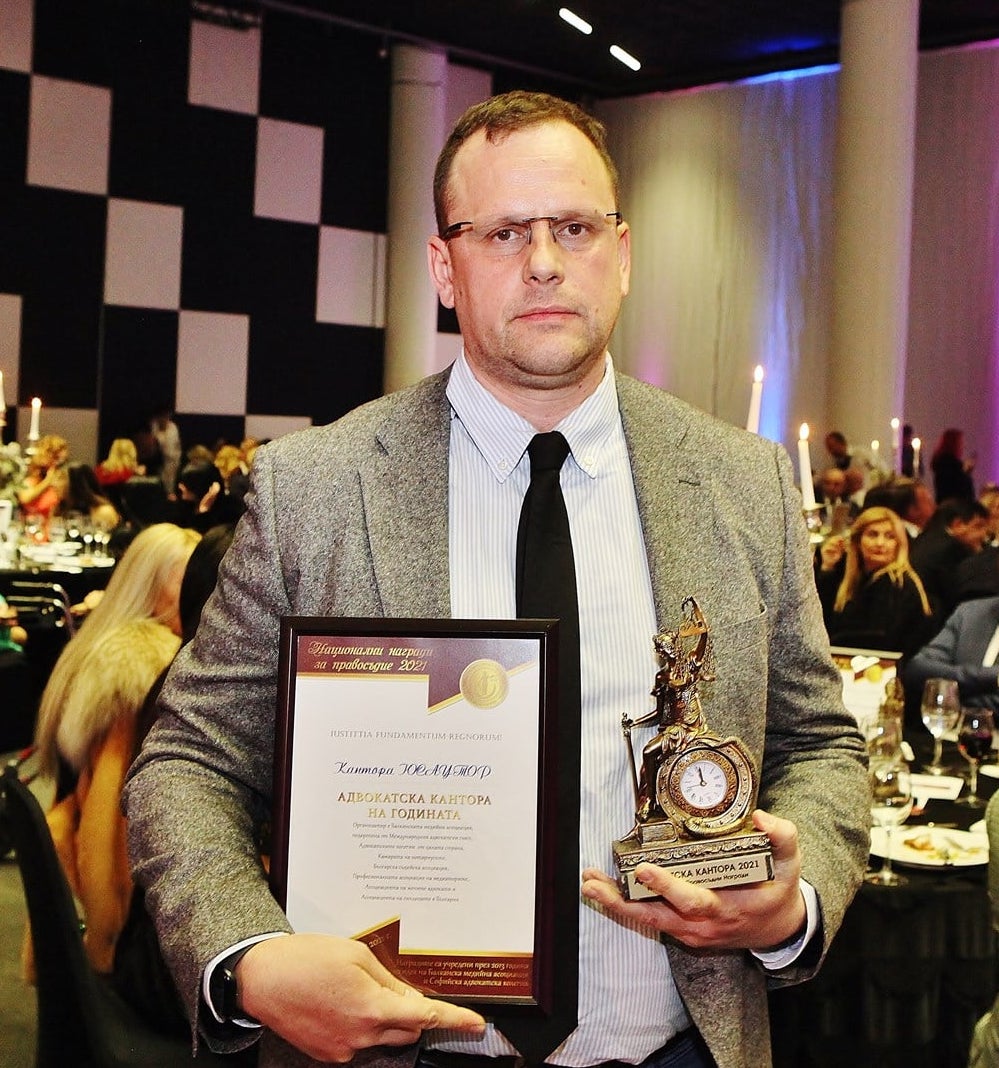
"IUSAUTHOR is the law firm of the year in Bulgaria for 2021.
On December 3, 2021 (Friday) at an official ceremony in the Hotel "Marinella", Sofia, were held the National Justice Awards, which are organized by the "Balkan Media Association", with the support and assistance of the International Bar Association, the Bar Associations throughout the country, the Chamber of Notaries, the Bulgarian Judges Association, the Professional Association of Mediators, the Association of Women Lawyers, the Association of Insolvency Practitioners in Bulgaria.
The awards in the various nominations - Lawyer of the Year, Law Firm of the Year, Judge of the Year, Prosecutor of the Year, etc., are voted by journalists from the justice sector who attend the ceremony, as well as by a professional jury, which this year was composed of professors Ognian Gerdzhikov and Atanas Semov, EU General Court Judge Mariana Kancheva and lawyer Vladimir Donchev.
- Details
- Written by Atanas Kostov

The hottest blockchain startups in Bulgaria.
Bulgaria and local dev community haven’t been too vocal about this, but it seems that the country has an important stake in the global blockchain ecosystem. With a growing community around the technology (not the fading crypto enthusiasm), the global acceleration program of platform Aeternity for blockchain startups and the investment company Belayer based in Sofia, a Balkan Blockchain Association seem to be well positioned on the map.
Currently, there are around 30 companies in Bulgaria, both service and product-oriented ones, which leverage blockchain technology in an attempt to develop viable products that serve real business needs. “The majority of blockchain companies right now are part of the transition from a centralized to a decentralized economy. A lot of them are still using decentralized components to solve problems but still have a centralized point of strategic decision-making. The most interesting projects are the ones that change the whole paradigm and really manage to confirm the viability and sustainability of decentralized models of governance and operation. This will not happen overnight.”, Vladislav Dramaliev from aetertnity, told us. Currently, there are around 30 companies in Bulgaria, both service and product, which leverage the blockchain tech in one way or another, in attempt to develop viable products that serve real business needs.
Here’s the list of the scalable product projects that might have found a way to utilize the technology to solve problems, instead of finding the problem for the blockchain solution. We’ve mostly looked at products beyond the crypto bubble. You can find below what is each of them doing.